

Running a business can be tough. You have to do everything from managing leads to following up with customers. This takes a lot of time. Small business owners often get stuck doing the things over and over again. These tasks take up a lot of time and energy.
The good thing is that you do not need to be a company to use automation. Now small businesses can use free automation tools to make their work easier save time and make money. You can do all of this without paying for ads or expensive software.
Automation is not about getting things done faster. It is about working in a way. When you use automation correctly your small team can handle tasks that you do every day. You can talk to your leads regularly track how you are doing and focus on things that help your business grow. The best thing is that you do not need a lot of money or to be good with technology to use automation.
In this guide we will talk about the free automation tools for small businesses like yours. We will show you how to use each tool step by step. We will give you examples of businesses that are using these tools. We will also give you tips on how to make automation workflow for you. By the time you finish reading this guide you will know how to set up automated workflows be more productive and do manual work. You can do all of this without spending any money on paid tools.
We will explore automation tools, for small businesses. We will describe how to use each free automation tool. We will provide examples of businesses using these free automation tools. We will share tips to make these free automation tools work for your business.
Why Small Businesses Should Automate
Automation is not something that small businesses can just have if they want to. It is something that they really need to have if they want to grow in a way that will last. Here is why Small Businesses Should Automate:
- Time-Saving: Small Businesses can automate tasks like sending follow-up emails to customers updating records and scheduling social media posts for Businesses. This gives Businesses back hours of work that they can use for other things.
- Accuracy: When Small Businesses automate tasks, they can be sure that every task will happen on time and will be done correctly which means there will be mistakes made by people.
- Improved Productivity: When tasks are automated for Small Businesses, the teams that work for Businesses can focus on work that is creative and involves making plans instead of just doing the same tasks over and over.
- Cost-Effective Growth: There are tools that Small Businesses can use for free that can handle tasks that Small Businesses would otherwise have to hire more people to do or buy expensive software to do.
- Scalable Processes: As Small Businesses grow and get bigger the automated systems that Small Businesses have in place can handle the increased amount of work without needing any effort from Small Businesses.
Small Businesses that use automation can stay competitive with businesses respond faster to customers of Small Businesses and focus on the areas of their business that will help them grow in the long run instead of just focusing on the day-, to-day work of Small Businesses.
Benefits of Using Automation Tools:
| Benefit | How It Helps |
| Saves Time | Automates repetitive tasks like emails and notifications |
| Improves Accuracy | Reduces human errors in tasks like data entry |
| Boosts Productivity | Frees employees to focus on revenue-generating work |
| Enhances Customer Experience | Ensures timely responses and follow-ups |
| Scalable Operations | Handles growing business processes effortlessly |
How to Choose the Right Automation Tool?
To pick the automation tool you need to know what your business needs. Think about this:
- What tasks take up most of your time?
- What tasks do you do over and over that always follow the rules?
- Where do you make mistakes the most?.
- What work can be automated without needing to be a tech expert?
When you figure out these things you can look at the automation tools. Choose the ones that fit your needs. This way you can get the most out of the automation tool. It will really make a difference, for your business and the automation tool.
Top Free Automation Tools for Businesses:
I want to tell you about the best free automation tools for small businesses. These are the tools that small businesses can use for free, without having to pay for any advertisements.
1. HubSpot Free CRM. It Helps You Manage Your Leads:
The HubSpot Free CRM is a tool that helps people who own businesses keep track of the people they talk to manage the sales process send follow-up emails automatically and see how their sales are doing. The HubSpot Free CRM is easy to use, for people who are just starting out and you do not need to know how to code.
The HubSpot Free CRM is best for:
- Managing. The people you talk to
- Sending follow-up emails
- Automating the sales process
The main features of the HubSpot Free CRM are:
- You can see a timeline of all the things that have happened with a contact
- The HubSpot Free CRM can automatically send follow-up emails for you
- You can make templates for your emails
- You can see how your deals are doing on a dashboard
Here is how you can set it up:
- First you need to sign up for the HubSpot Free CRM.
- Then you need to add all the people you talk to into the HubSpot Free CRM.
- Next you make email templates that the HubSpot Free CRM can use to send follow-up emails.
- After that you set reminders and follow-ups.
- Finally, you can see how your deals are doing. The HubSpot Free CRM can automatically update the status of your deals.
For example, a small company that helps people, with marketing used the HubSpot Free CRM to send follow-up emails. The people they were trying to sell to get emails that were personalized for them and this helped the company get 30 percent more people to buy from them over two months. The HubSpot Free CRM really helped this company manage its leads.
2. MailerLite has a plan that helps you send automated emails:
MailerLites free plan lets you create email campaigns that send automatically. You can use it for drip campaigns group your audience into segments. Send welcome emails.
This is good for:
- Sending a series of emails one after another
- Nurturing leads with a sequence of emails
- Personalizing emails for your subscribers
MailerLite free plan is good, for automation.
Key Features:
| Feature | Description | Benefit |
| Email Automation | Automated sequences based on triggers | Saves manual email work |
| Landing Pages | Build forms to capture leads | Converts website visitors into leads |
| Subscriber Segmentation | Group leads based on behavior | More personalized messaging |
| Analytics | Track open and click rates | Measure campaign performance |
Here is what you can do:
- First you capture a lead through a form.
- Then a welcome email is sent to the lead automatically.
- After that you send follow-up emails to the lead at scheduled times.
- You also segment the subscribers based on how they engage with the emails to make the future messages more personal for the subscribers.
For example, a small SaaS company used MailerLite to set up a three-step email sequence.
This helped the company to nurture the leads automatically.
As a result, the company had a 25 percent increase in trial signups, in one month.
3. Zapier (Free Tier) -Connect Apps and Automate Workflows:
Zapier is a tool that helps you connect lots of apps together. This means that when something happens in one app it can make something happen in another app.
Best For:
- Linking apps, like Gmail, Sheets, customer relationship management tools and Slack
- Doing the tasks over and over again but automatically
Here is a real example of how this works:
- A new person is added to Google Sheets. Then that person automatically gets added to HubSpot.
- MailerLite sends that person an email.
- Slack sends a message to the sales team to let them know.
This way you do not have to enter the information into lots of different apps. It also helps make sure that you follow up with people at the time. Zapier does this for you so you can focus on things.
4. Google Sheets + Google Forms – Capture and Organize Leads:
Google Forms and Google Sheets are useful tools that can help us automate things.
Best For:
- Collecting information from people who’re interested in what we do
- Organizing data without having to do it ourselves
- Sending information to tools that can help us automate our work
How It Works:
- We can create a Google Form to get information from people.
- The information people give us is automatically saved in Google Sheets.
- Then we can connect Google Sheets to Zapier so it can send automated emails or do tasks for us.
Real Example:
A design studio in our area used Google Forms to get information from people who wanted to work with them.
The information, from Google Forms went into Google Sheets automatically.
Then it triggered emails to go out to those people through MailerLite, which saved the design studio a lot of time every week.
Google Forms and Google Sheets really helped the design studio with their workflow.
5. Trello (Free Version) – Project and Workflow Automation:
Trello helps organize tasks in a way, with boards, lists and cards. It has a free automation tool called Butler that can do tasks for you.
Best For:
- Team task assignment
- Managing project workflows
- Tracking progress
Automation Example:
- For instance, when you move a card to “Completed” it can automatically update dates and send a notification on Slack.
Real Example:
A small creative agency saved 20% of their project management time by using Trello to automate notifications and update tasks.
The agency used Trello to automate notifications and task updates which helped them save time.
6. Notion (Free Personal Plan) -Templates and Knowledge Management
Best For:
- SOP documentation
- Content calendar management
- Task tracking
For example, when Notion is used to make a copy of a client onboarding template for every client it saves time and makes sure everything is done the same way every time. Notion really helps with this because it lets you make a template one time and then use it for every client. Using Notion for this kind of thing is a help, for small businesses. Notion makes it easy to keep everything organized and consistent.
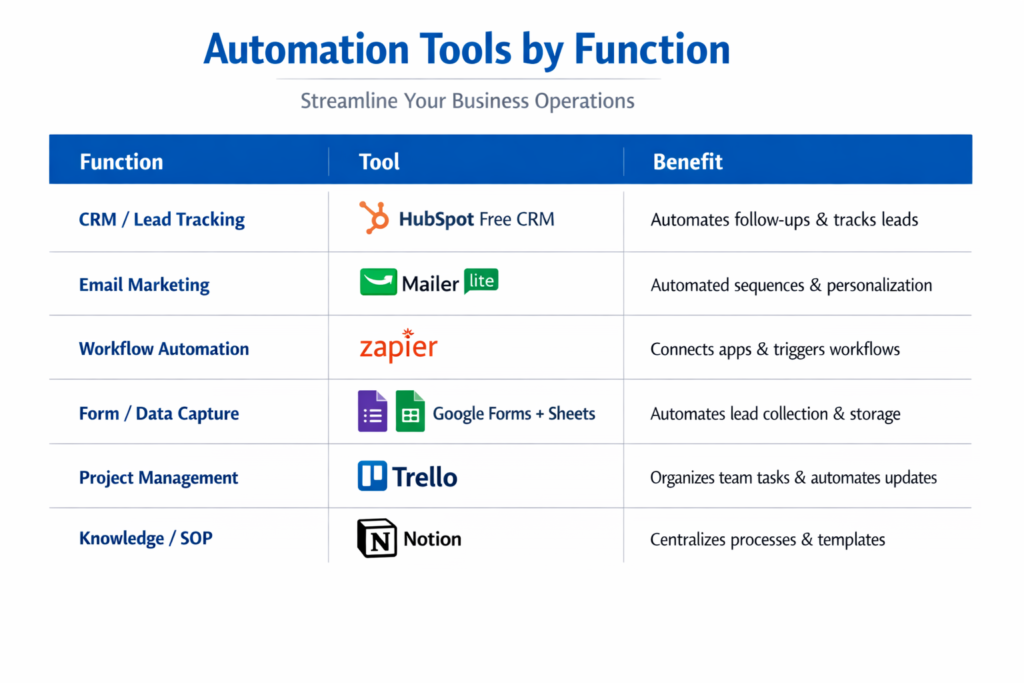
Automation Tools by Function
| Function | Tool | Benefit |
| CRM / Lead Tracking | HubSpot Free CRM | Automates follow-ups & tracks leads |
| Email Marketing | MailerLite | Automated sequences & personalization |
| Workflow Automation | Zapier | Connects apps & triggers workflows |
| Form / Data Capture | Google Forms + Sheets | Automates lead collection & storage |
| Project Management | Trello | Organizes team tasks & automates updates |
| Knowledge / SOP | Notion | Centralizes processes & templates |
Step-by-Step Example Workflow: Lead Follow-Up Automation:
Lead Follow-Up Automation is what we are going to talk about.
The main goal is to automate follow-ups for leads so we can get more people to engage with us and turn them into customers.
We will use a tool to do this:
- Google Forms
- Google Sheets
- Zapier
- MailerLite
Here is how we do it:
- Step 1: We create a Google Form to get information from leads.
- Step 2: When people fill out the form their answers automatically go into Google Sheets.
- Step 3: Then Zapier tells MailerLite to send an email to the new lead.
- Step 4: After that MailerLite sends another email to the lead 2 days to follow up.
- Step 5: We separate the leads, into groups based on how they engage with us so we can plan our future email campaigns better.
Best Practices for Small Business Automation
- When you are getting started with Small Business Automation start simple. Focus on one workflow at a time for Small Business Automation.
- You should document all of your processes for Small Business Automation. You can use tools like Notion or Trello to track all of your workflows for Small Business Automation.
- You need to test all of your workflows for Small Business Automation. Make sure all of the triggers fire correctly and that all of the data flows as you expect it to for Small Business Automation.
- It is also an idea to monitor your metrics for Small Business Automation. You should track things like email opens and clicks and lead conversions and response times, for Small Business Automation.
Common Mistakes to Avoid:
| Mistake | Effect | Solution |
| Automating too many processes at once | Confusion & errors | Start small and scale gradually |
| Ignoring performance tracking | Leads not converting | Set KPIs and measure results |
| Impersonal communication | Lower engagement | Use personalized fields in emails |
| No backups | Lost automation setup | Regularly export data and workflows |
Checklist: Are You Ready to Automate Your Small Business?
- Find tasks you do over. Over
- Pick free tools that work for you
- Create a plan for automating tasks
- Try it out. See if it works
- Keep an eye, on numbers often
- Make changes based on how things are going
Conclusion:
Using automation is something that small businesses really need to do if they want to get bigger without much trouble. There are some tools like HubSpot CRM, MailerLite, Trello, Zapier, Google Forms and Notion that can really help small businesses save time avoid mistakes and get more customers involved all without spending money on ads.
If you set up your automation to work in steps watch what happens and make changes to make it better your business can get a lot done manage customers well and see real growth all while not spending too much money. Automation like this can really help your business. Using tools, like HubSpot CRM and Notion can make it easier to do things right.
FAQS
Q1: Can small businesses really automate without paid software?
A: Yes, using tools like HubSpot Free CRM, MailerLite, Trello, Notion, and Zapier’s free tier.
Q2: Do I need coding skills?
A: No, these tools are designed for no-code automation.
Q3: Which tasks should I automate first?
A: Lead follow-ups, email sequences, task reminders, and data transfer between apps.
Q4: Can automated emails feel personal?
A: Yes, using personalization tags and segmentation improves engagement.
Q5: How long before I see results?
A: You can see improvements within weeks for workflows like lead follow-ups, while full productivity gains may take 1–3 months.