

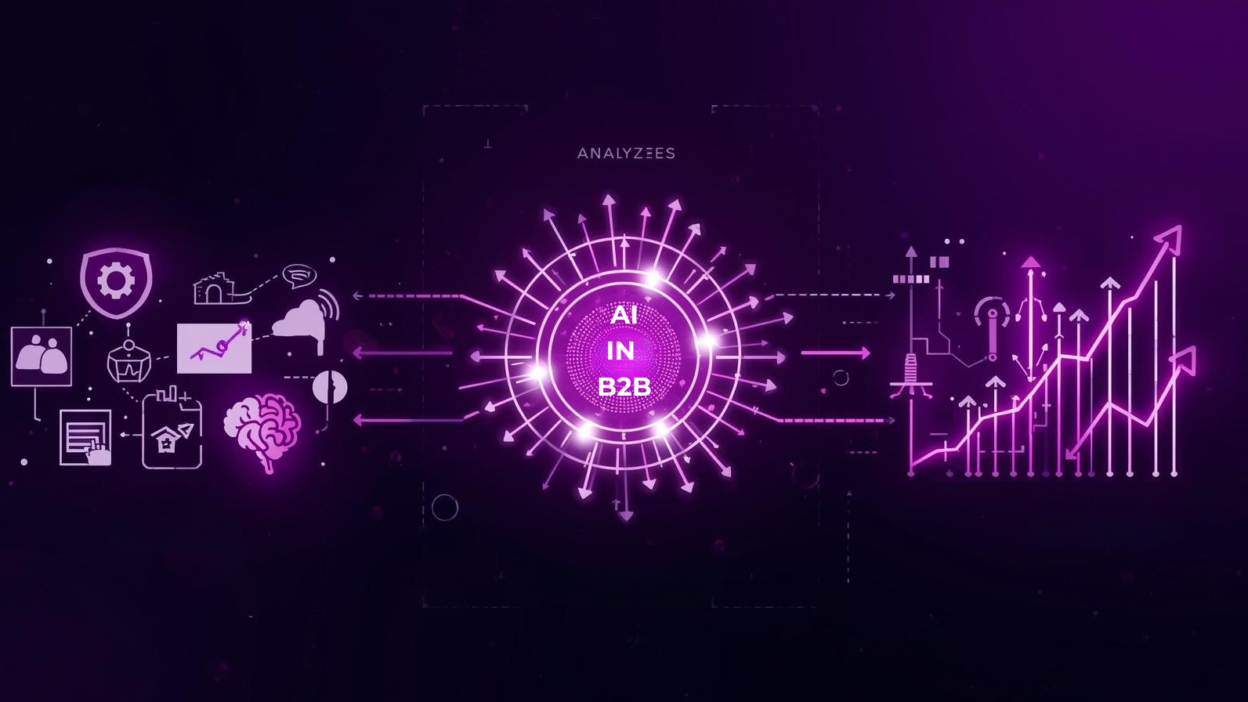
Generating demand in the B2B space is not about sending emails or posting on LinkedIn. It is about creating connections with the right audience at the right time. The B2B space requires this kind of connection. This is where AI for B2B Demand Generation can really help. AI for B2B Demand Generation becomes an ally by helping businesses. By using intelligence businesses can find high-potential leads. They can also personalize interactions with these leads. Furthermore businesses can streamline their marketing efforts with AI, for B2B Demand Generation.
In a marketplace traditional methods often do not work. Manual lead scoring can be slow. Generic campaigns do not work well either. Inconsistent follow-ups can also slow growth. The B2B space is crowded. AI for B2B Demand Generation changes the game. AI allows marketers to look at a lot of data. They can predict what will happen. Marketers can then create campaigns that really work. These campaigns are tailored to the audience. They really resonate with the audience.
The Role of Artificial Intelligence in Modern Business to Business Marketing:
Artificial Intelligence is changing Business to Business marketing by bringing in automation and helping us understand what is likely to happen. It is also helping us make our marketing efforts more personal for each person. Artificial Intelligence is not something that companies can do without if they want to get good leads all the time.
There are some ways that AI helps with creating demand for Business to Business products. These include:
- Lead Scoring: AI looks at which leads are most likely to become customers.
- Behavioral Analytics: This tracks what people do when they interact with our marketing efforts so we can make our campaigns better.
- Automated Personalization: This delivers content that is tailored to each person who’s interested in our products.
- Conversational Artificial Intelligence: These tools talk to leads all day and night on our websites or other platforms.

One good idea is that combining AI with our Customer Relationship Management system allows us to group our customers in a way and have more effective outreach campaigns. AI is really important for Business, to Business marketing. It helps us understand our customers better.
AI Tools for B2B Demand Generation
Here are some AI-powered tools that are making a significant impact in B2B demand generation:
| Tool | Function | Example Use Case |
|---|---|---|
| HubSpot AI | Marketing automation & predictive lead scoring | Segment leads automatically and predict conversion likelihood |
| Salesforce Einstein | AI insights & forecasting | Identify high-value prospects and prioritize follow-ups |
| Drift | Conversational AI/chatbots | Engage website visitors instantly and qualify leads |
| Marketo Engage | AI-driven campaign personalization | Customize email campaigns based on behavioral data |
These tools help businesses get leads without having to do as much work so marketing teams can think about the big picture instead of doing the same things over and over.
Crafting an AI-Powered B2B Demand Generation Strategy
To really use AI well companies need a plan that they can follow. Here is how to make one:
Step 1: Define Your Target Audience
Before you use AI you need to know who your audience is. AI helps make accurate pictures of the people who might buy from you by looking at what they do what their company is like and how they interact with you.
Example:
A company that sells software might use AI to find out which sized tech companies are most likely to buy a tool to manage their customers based on what they do, on the website and what they have done before. AI helps the company understand their audience and the company can use AI to make a plan to reach these people the target audience and sell to them.
Step 2: Implement AI for Lead Scoring and Qualification
Lead scoring is essential in B2B marketing. AI evaluates leads using multiple data points, from email engagement to social media interactions, giving your sales team a prioritized list.
| Lead Attribute | Traditional Scoring | AI-Powered Scoring |
|---|---|---|
| Job Title | 1 point | Weighted based on relevance and buying potential |
| Website Visits | 1 point | AI tracks behavior and engagement trends |
| Email Opens | 1 point | AI predicts likelihood to convert |
With AI, your team spends more time closing deals rather than chasing low-quality leads.
Step 3: Make Campaigns More Personal with AI
To get results you need to make your campaigns personal. AI helps marketers create emails, ads and content that are just right for each person.
For example:
- AI notices that a lead often looks at pages where they compare your product to others.
- The system then sends them an email that shows how your product is better than the competition.
When you do this people are more likely to engage with your campaigns and convert. This is compared to when you send out campaigns.
Step 4: Get Better Results from Multiple Channels with AI
AI is not for email. It can also help you get results, from LinkedIn campaigns PPC ads and even retargeting efforts.
Here are some ways AI can help:
- AI figures out the time to send messages to people.
- It adjusts how much you spend on ads based on how they are to convert.
- It gives you insights into which content works best with your audience.
Measuring Success: KPIs and Analytics, with AI
To make sure your Artificial Intelligence strategy works well you need to pay attention to these things:
- MQL, which is Marketing Qualified Leads is one thing to look at. Artificial Intelligence helps by finding people who’re likely to buy. For example you can get 25 percent MQLs.
- SQL or Sales Qualified Leads, is another thing. Artificial Intelligence helps by figuring out which people are ready to buy. This means you can reduce the number of people who stop being interested.
- Conversion Rate is also important. Artificial Intelligence helps by making campaigns more personal. You can get 30 percent more people to buy.
- ROI or Return On Investment is the thing. Artificial Intelligence helps by giving you reports and insights. This means you can see which campaigns are working the best and focus on those.

You should track these Artificial Intelligence performance indicators to see how well your strategy is working. Artificial Intelligence can really help you with this.
Case Studies: Companies Using AI for Demand Generation
Tech Software as a Service Company
- The problem was, they were not getting leads from their website visitors.
- They used AI chatbots and a system that could predict which leads were likely to become customers.
- This resulted in a 40 percent increase in leads and they were able to close sales 20 percent faster.
Business, to Business Manufacturing Firm
- The issue was their marketing campaigns were not targeting the people.
- They used Artificial Intelligence to look at buyer behavior and group potential customers together based on that.
- This led to 35 percent people engaging with them and their outreach efforts were more focused.
Common Challenges & How to Overcome Them
While AI is powerful, challenges exist:
- Data Quality: Poor data leads to inaccurate predictions.
- Solution: Regularly clean and update databases.
- Integration Issues: AI tools may not integrate seamlessly.
- Solution: Use platforms with robust APIs or CRM integration.
- Measuring ROI: Hard to track AI impact.
- Solution: Set clear KPIs and track campaign performance.
Future Trends in AI for B2B Demand Generation
- Predictive Lead Scoring: Continues to improve with machine learning.
- Generative AI for Content: Automatically creates personalized marketing content.
- Hyper-Personalization: Real-time adjustments in campaigns based on user behavior.
- Advanced Chatbots: Handle complex queries and drive conversions.
Key Takeaways & Best Practices
- Use AI tools wisely: Focus on tasks that truly enhance efficiency.
- Prioritize personalization: Customized campaigns yield higher engagement.
- Monitor KPIs regularly: Continuously improve AI models.
- Start small: Test AI on specific campaigns before scaling.
Conclusion:
AI is not something we see in movies anymore. It is something we use every day. Artificial Intelligence is an useful tool for businesses that want to get more customers. By using Artificial Intelligence for getting business customers companies can find good potential customers faster make advertisements that are just for them and make the whole process of buying easier.
AI can do a lot of things like predict which people are more likely to buy something and send messages to people through different ways. This means that people who do marketing work can focus on important things and get better results, which means they can sell more and make more money.
To be successful you need to have a plan choose the right Artificial Intelligence tools and always check how things are going. If you use Artificial Intelligence your company can be better than others give people what they really want and make your marketing work better.
Take Action: Do not wait to use Artificial Intelligence to get business customers. Start with something try it out and then make it bigger to see real growth. The future of marketing to businesses is smart, automated and just, for each person.. We can do it now with Artificial Intelligence.
FAQS
Q1: What is AI for B2B Demand Generation?
AI for B2B demand generation uses intelligence to automate marketing campaigns. It helps analyze and optimize them. This increases lead quality and conversion rates for B2B demand generation.
Q2: How can AI improve lead scoring?
AI looks at data points. These include website behavior and email interactions. It also checks engagement. Then it prioritizes leads that’re likely to convert into customers.
Q3: What are the best AI tools for B2B marketing?
Some popular AI tools for B2B marketing are:
- HubSpot AI
- Salesforce Einstein
- Drift
- Marketo Engage
These tools help with lead scoring, personalization and automation of engagement.
Q4: Is AI expensive for businesses?
AI tools can be scaled. Many platforms offer options that are suitable for small and medium-sized businesses (SMBs). They provide automation and insights.
Q5: Can AI replace marketers?
No AI cannot replace marketers. AI helps marketers by automating tasks. It also provides insights. This allows human teams to focus on strategy and creativity in marketing.
Q6: How do I measure AI success in demand generation?
To measure AI success in demand generation track performance indicators (KPIs), like:
- Marketing Qualified Leads (MQLs)
- Sales Qualified Leads (SQLs)
- Conversion rates
- Return on Investment (ROI)
AI analytics provides insights to optimize demand generation campaigns.